

You know a garage door repair company is licensed and insured when they give you a license number without hesitation and can produce proof of insurance in writing before work starts.
A company that hedges, delays, or gets defensive when asked either of these questions is telling you something important. The 7 questions below give you a simple way to check before a technician is ever in your garage.
Key Takeaways
- A legitimate company answers a license or insurance question immediately, without needing to “check with someone.”
- Proof of insurance should be available in writing, not just claimed verbally.
- How long a business has operated at a consistent address is a useful, easy-to-check signal.
- Asking whether your technician is an employee or a subcontractor affects who’s actually accountable for the work.
- Knowing what happens if something goes wrong after the repair matters as much as the repair itself.
Questions to Ask vs. Red-Flag Answers
| Question | Legitimate Answer | Red-Flag Answer |
| License number | Given immediately, verifiable | Delayed, vague, or refused |
| Insurance proof | Provided in writing on request | “We’re insured, don’t worry about it” |
| Business history | Real address, consistent over time | No fixed address, recently changed name |
| Reviews | Mix of older and recent, consistent tone | Almost entirely recent, generic wording |
| Technician status | Clear answer: employee or subcontractor | Evasive or unclear |
| After-repair issues | Clear warranty and follow-up process | No plan, “that won’t happen” |
Here are the 7 questions worth asking before you schedule anything.
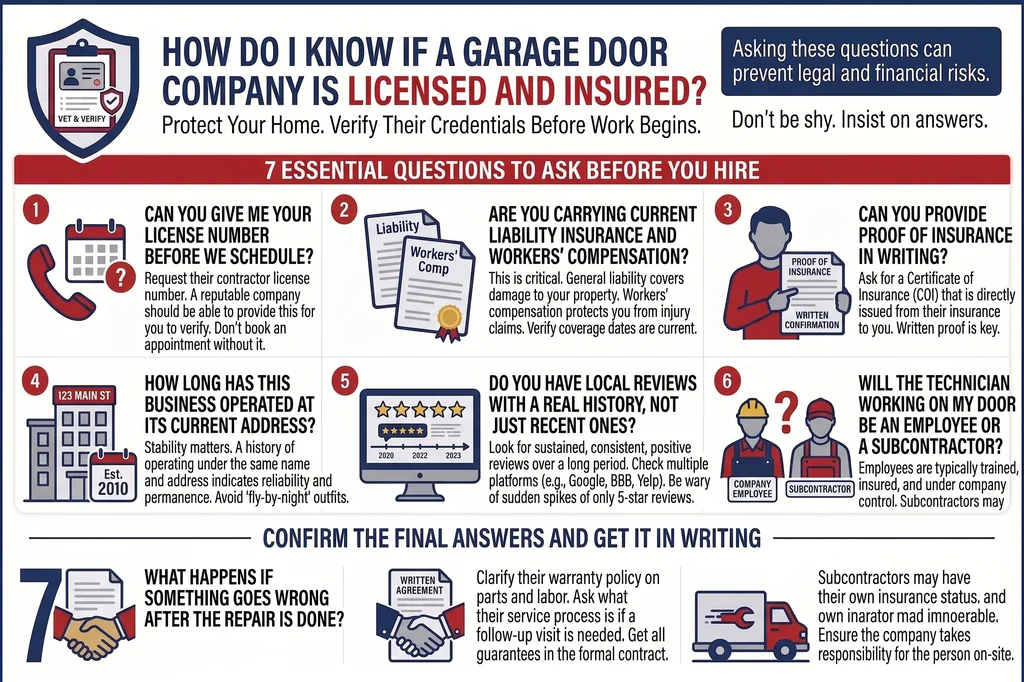
1. Can You Give Me Your License Number Before We Schedule?
This should be one of the easiest questions a legitimate company answers, and one of the fastest ways to filter out operators who aren’t licensed at all.
How a Company With Real Credentials Answers
The number is provided immediately, over the phone or by text, before any appointment is booked.
How to Fix Not Being Able to Get a License Number Upfront
Ask before you schedule, not after a technician arrives. If the answer is delayed, vague, or you’re told “the technician will bring that,” treat that as a real answer: no.
If you want to see all 9 warning signs, read How to Avoid Garage Door Repair Scams.
Companies that dodge this question are often the same ones that quote one price on the phone and a much higher one once they’re standing in your garage. If that’s happened to you, read Why Did My Garage Door Repair Quote Change After the Technician Arrived? 5 Signs of a Bait-and-Switch Scam.
2. Are You Carrying Current Liability Insurance and Workers’ Compensation?
Insurance protects you if something is damaged during the repair, and protects you from liability if a technician is injured on your property.
What You Should Hear From a Legitimate Business
The company answers clearly and can name the type of coverage they carry without hesitation.
How to Fix Uncertainty About a Company’s Insurance Coverage
Ask directly which types of coverage they carry. A vague “yeah, we’re covered” with no detail is worth following up on before you commit.
3. Can You Provide Proof of Insurance in Writing?
A verbal claim of insurance means little if it can’t be backed up. A real certificate of insurance can be sent to you as a document, not just described.
The Response of a Company That Has Nothing to Hide
The company sends a certificate of insurance by email or text without pushback.
How to Fix a Company That Won’t Provide Written Proof of Insurance
Ask specifically for a certificate of insurance, not just a verbal confirmation. Reluctance to send one is a meaningful signal on its own.
4. How Long Has This Business Operated at Its Current Address?
A company with a real, stable local presence is generally easier to hold accountable than one with no fixed address or a recently changed business name.
The International Door Association encourages exactly this kind of homework before hiring, and publishes ongoing guidance for consumers on its Scam Awareness page. The association also recently shared a LinkedIn post highlighting how often unverified, fly-by-night operators show up in this exact space.
What a Verifiable Business Looks Like
A quick search confirms a real, consistent address and a business history that matches what the company tells you.
How to Fix Uncertainty About a Company’s Business History
Search the company name plus your city and look for a consistent address across their website, reviews, and any public business listings.
5. Do You Have Local Reviews With a Real History, Not Just Recent Ones?
A pattern of reviews spanning more than a few months, with some variation in wording and detail, generally reflects a real, established business. A page of almost entirely recent, similarly worded reviews is worth a second look.
How Genuine Customer Feedback Reads
Reviews span a meaningful period of time and read like they were written by different people describing different jobs.
How to Fix Reviewing a Company With Suspiciously Uniform Feedback
Sort reviews by date and read a handful from different time periods. Genuine variation in detail and tone is a good sign; near-identical wording across many recent reviews is not.
6. Will the Technician Working on My Door Be an Employee or a Subcontractor?
This affects who’s actually accountable if something goes wrong. It’s a fair, normal question, and a company with nothing to hide will answer it plainly.
What Real Accountability Sounds Like
You get a clear, direct answer either way, along with an explanation of how that affects warranty or liability.
How to Fix Not Knowing Who’s Actually Doing the Repair
Ask directly, and ask how that answer affects your warranty coverage if something goes wrong later.
7. What Happens If Something Goes Wrong After the Repair Is Done?
A company confident in its work will have a clear answer: a warranty period, a follow-up process, a number to call. A company with no plan for this is a company you have no real recourse with.
The Answer a Confident Company Gives
The warranty terms and follow-up process are explained clearly and, ideally, provided in writing.
How to Fix a Company That Has No Plan for Post-Repair Issues
Ask for the warranty terms before you pay the final invoice, and make sure the answer covers:
- How long parts and labor are each covered
- Whether the warranty is written, not just spoken
- Who to call if the same issue comes back
If the answer is vague or dismissive, that tells you what to expect if a problem does come up.
A company with no real warranty plan is also frequently one that pushes an unnecessary part replacement to begin with. If you’ve also been told a spring needs replacing, read Does My Garage Door Spring Really Need Replacing? 6 Signs a Repair Company Is Overselling You.
The Credentials Check That Protects You
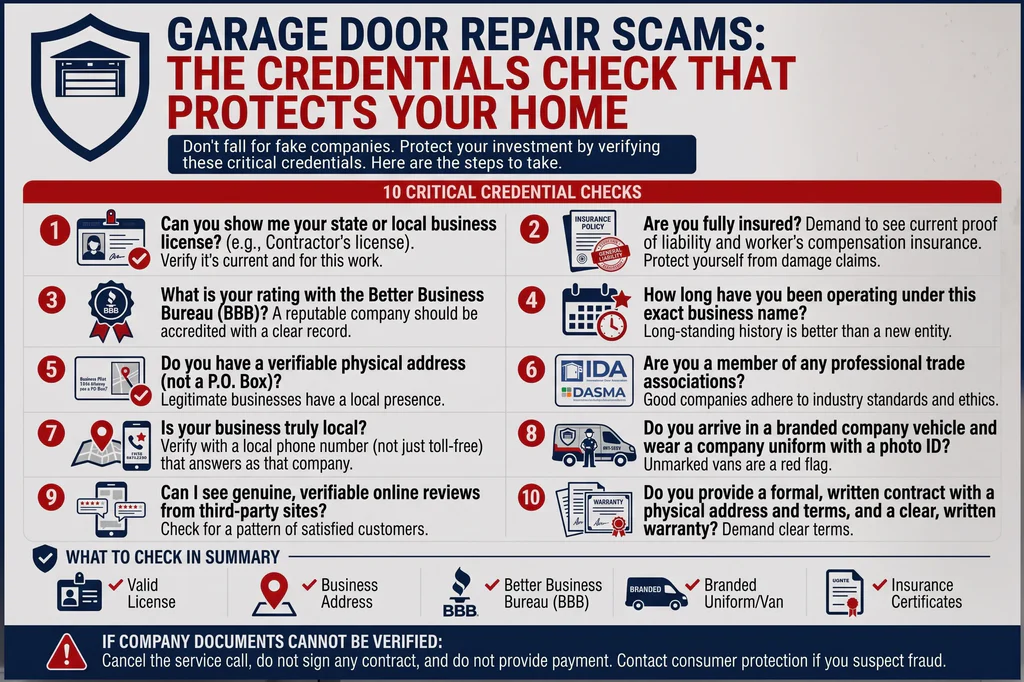
Asking these 7 questions before you schedule takes a few minutes and eliminates most of the risk of hiring an unverified operator. It’s the fastest, most reliable filter you have before a stranger ever steps into your garage, and it costs you nothing but a little patience.
Ocean Coast Garage Doors provides license and insurance information on request, with no hesitation and no runaround, because we have nothing to hide about who’s doing the work on your home. Every technician we send is licensed, insured, and accountable for the job from start to finish. If you’d like to verify our credentials before booking, contact us today or give us a call.
Frequently Asked Questions
What's the difference between licensed and insured?
A license shows the company or technician has met the requirements to legally operate. Insurance protects you financially if something is damaged during the repair or if someone is injured on your property. You want both, not just one.
Is it rude to ask a garage door company for proof of insurance?
No, and in our experience, a legitimate company expects the question and answers it without any pushback. If asking makes a technician defensive, that reaction tells you something on its own.
How do I know if online reviews are real?
Look for variation in wording, specific details about the job, and a spread of dates rather than a cluster of similar, recent posts. Our rule of thumb from the field: genuine reviews read like different people, not the same script repeated.
Does it matter if my technician is an employee or a subcontractor?
Yes, it affects accountability. It's a fair question to ask, and a company with a straightforward answer is generally easier to work with if a problem comes up later.
What should a warranty on garage door repair actually cover?
In our experience, a clear warranty specifies a time period and exactly what's covered: parts, labor, or both. A vague answer, or none at all, leaves you without protection if the repair fails.
Can I still get scammed by a company that is technically licensed?
Yes. Licensing filters out one category of risk, but a licensed company can still oversell parts or use pricing pressure. Use all the questions on this list together rather than relying on licensing alone.
How long should a legitimate garage door company have been in business?
There's no fixed number, but a consistent address and review history over a meaningful period of time is a reassuring sign. A business that changed its name recently or has no fixed address is worth extra caution.
What if a company refuses to answer these questions?
Treat that refusal as your answer. One of our most common calls for a second opinion starts with someone realizing, after the fact, that a company avoided exactly these kinds of questions upfront.
Where can I verify a company's credentials on my own?
Search the company name alongside your city, check review platforms for a real history, and don't hesitate to ask the company directly for documentation. A legitimate business will make this easy, not difficult.

