
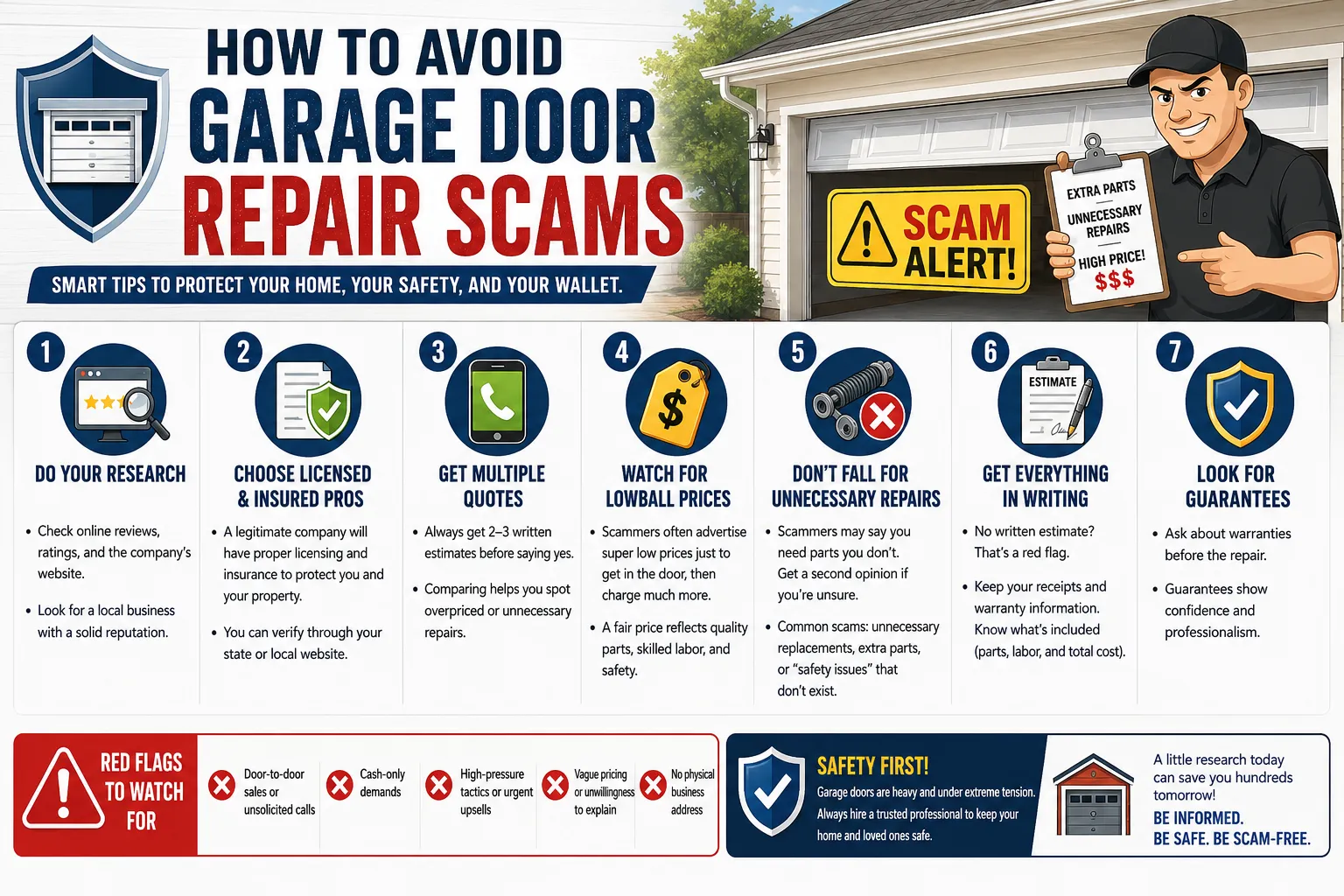
Avoid garage door repair scams by getting a written estimate before any work starts, verifying the technician’s license and insurance, and refusing to pay in full upfront or in cash only.
Most scams follow the same pattern: a low advertised price gets a technician in the door, then they “find” an urgent problem and pressure you into an expensive repair on the spot. The 9 warning signs below are the fastest way to protect your home and your wallet.
Key Takeaways
- A quote that jumps significantly once the technician is on-site is the single most common garage door scam pattern.
- Legitimate technicians show you the broken part and explain the failure before recommending a repair.
- A real garage door company produces proof of license and insurance without hesitation.
- Cash-only demands, full payment upfront, or “today only” pricing are red flags across home service scams generally.
- Getting two or three quotes before agreeing to a spring or opener replacement protects you from being oversold.
- The International Door Association actively tracks and publishes garage door scam reports for consumers.
Legitimate Company vs. Scam: What to Look For
| Signal | Legitimate Company | Likely Scam |
| Pricing | Written estimate matches final invoice | Price jumps significantly once on-site |
| License/Insurance | Provided immediately, no hesitation | Vague, delayed, or refused |
| Payment | Due on completion; card/check accepted | Full payment upfront, cash only |
| Diagnosis | Shows you the failed part and explains it | Says it’s broken without evidence |
| Urgency | Explains real risk calmly, allows time to decide | Pushes same-day, no-time-to-think pressure |
| Business presence | Verifiable local address, consistent reviews | No address, brand-new reviews, mismatched phone number |
| Warranty | Clear terms in writing | None offered, or vague when asked |
9 Warning Signs of a Garage Door Repair Scam
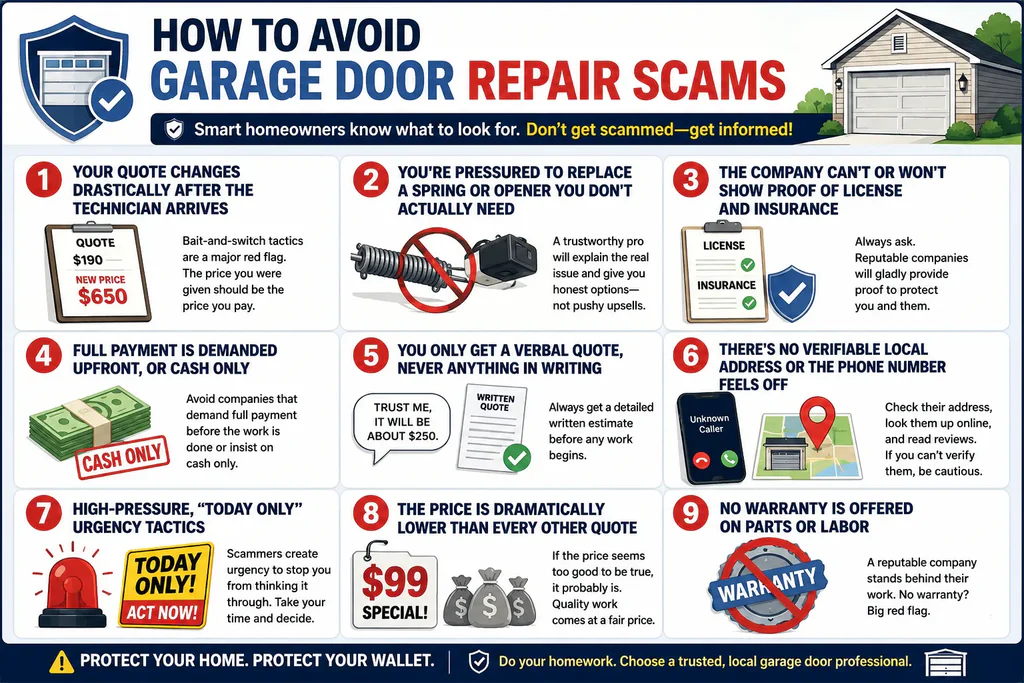
Ordered by how often our technicians actually see each tactic in the field, starting with the most common.
1. Your Quote Changes Drastically After the Technician Arrives
The advertised price gets you a same-day appointment. The technician arrives, looks at the door for thirty seconds, and says the job is now three or four times the original quote. The low price was never meant to be honored; it exists to get someone inside your garage, where the pressure to say yes climbs fast.
What Legitimate Looks Like
You’ve gotten a written estimate from a second company and want a fair comparison before committing.
If this has already happened to you, read Why Did My Garage Door Repair Quote Change After the Technician Arrived? 5 Signs of a Bait-and-Switch Scam.
How to Fix a Garage Door Repair Quote That Changed On-Site
Ask the technician to point to the exact failed part and explain why it needs replacing. Get the new price in writing before any tools come out. A refusal to do either is itself the answer.
2. You’re Pressured to Replace a Spring or Opener You Don’t Actually Need
Springs and openers are the two most oversold parts in this industry: expensive, hard for homeowners to verify, and “it could snap” is an effective scare line. Springs genuinely are dangerous under tension, and scammers lean on that real danger to push unnecessary replacements.
How an Honest Company Handles This
Your door is noticeably harder to lift by hand, hangs unevenly when disconnected from the opener, or a spring has visibly separated. Those are real failure signs, not a sales tactic.
If you’ve been told your spring needs replacing, read Does My Garage Door Spring Really Need Replacing? 6 Signs a Repair Company Is Overselling You.
How to Fix an Overpriced or Unnecessary Spring Replacement Quote
Ask what specific test confirmed the failure, request the spring’s age if known, and get a second opinion before authorizing significant parts and labor.
3. The Company Can’t or Won’t Show Proof of License and Insurance
A real garage door company hands over a license number and proof of insurance without hesitation, because they have to carry both to legally operate. Unlicensed operators undercut on price by skipping that overhead, and if something goes wrong, you have no recourse.
The Above-Board Version
A technician who produces a license number when asked, arrives in a marked vehicle, and carries visible company identification.
If a company can’t answer this clearly, read How Do I Know If a Garage Door Company Is Licensed and Insured? 7 Questions to Ask Before You Hire.
How to Fix Hiring an Unlicensed or Uninsured Garage Door Company
Ask for the license number before scheduling, not after arrival. A company that won’t provide one over the phone has already answered.
4. Full Payment Is Demanded Upfront, or Cash Only
Legitimate companies collect payment once the job is finished and you’ve confirmed the door works. A demand for full payment before work starts, or insistence on cash only, is a pattern seen across home service scams generally.
What a Reputable Technician Does Instead
A deposit tied to ordered materials, explained clearly in writing, is normal. Full payment before a same-day repair begins is not.
How to Fix a Garage Door Company Demanding Upfront or Cash-Only Payment
Ask what payment methods they accept and when payment is expected. Cash-only, paid upfront, is a company to walk away from.
5. You Only Get a Verbal Quote, Never Anything in Writing
If a price only ever exists as something said out loud, nothing holds the company to it once the job is underway.
How This Plays Out With a Trustworthy Company
The company texts or emails a written estimate with parts, labor, and total price before the appointment.
How to Fix a Garage Door Repair That Has No Written Estimate
Ask directly for a text or email with the price broken down. “Just pay when I’m done” is a warning sign, not a convenience.
6. There’s No Verifiable Local Address or the Phone Number Feels Off
Some of the most reported garage door scams involve out-of-state call centers using a local-looking number to dispatch a technician with no real ties to your area.
What Should Actually Happen Here
A quick search of the company name turns up a real address, reviews with some history, and a phone number matching their website.
How to Fix Booking With a Company That Has No Local Presence
Search the company name plus your city before booking. No address and a mismatched phone number are worth a second look.
7. High-Pressure, “Today Only” Urgency Tactics
“Your door could come down and hurt someone if we don’t fix this now” is a real safety concern in genuine cases, and a manipulation tactic in scam cases. The difference is whether the technician can show you the actual failure.
The Straightforward, Non-Scam Version
The door is visibly off-track, a cable has snapped, or it won’t stay open at all. Those are real emergencies; a vague warning with no evidence is not.
How to Fix a High-Pressure “Fix It Today” Garage Door Sales Pitch
Ask what happens if you wait 24 hours for a second quote. A legitimate technician answers honestly; a scammer escalates instead.
8. The Price Is Dramatically Lower Than Every Other Quote
A quote far below every other estimate usually means the company plans to raise it once inside your garage, or they’re cutting corners you won’t notice until later.
How a Trustworthy Technician Responds
Two or three quotes land in a similar range. Consistency is reassuring; one wildly low outlier is not.
How to Fix Comparing a Suspiciously Low Garage Door Repair Quote
Get the low quote in writing and ask what parts and warranty are included. A vague answer means the low price was never real.
9. No Warranty Is Offered on Parts or Labor
A company confident in its work backs it up. No warranty, or one the technician can’t explain, leaves you unprotected if the repair fails within a month.
What a Company With Nothing to Hide Does
They tell you, without checking with anyone, exactly how long the parts and labor are covered.
How to Fix a Garage Door Repair With No Warranty Offered
Ask for the warranty terms in writing before paying the final invoice. A non-answer is its own red flag.
Trade groups track these patterns closely because they show up in the same handful of forms across the country. The International Door Association publishes ongoing scam warnings for homeowners on its Scam Awareness page, and recently flagged a current example of this exact bait-and-switch pattern in a LinkedIn post from the association.
Protecting Your Home Starts With Asking the Right Questions
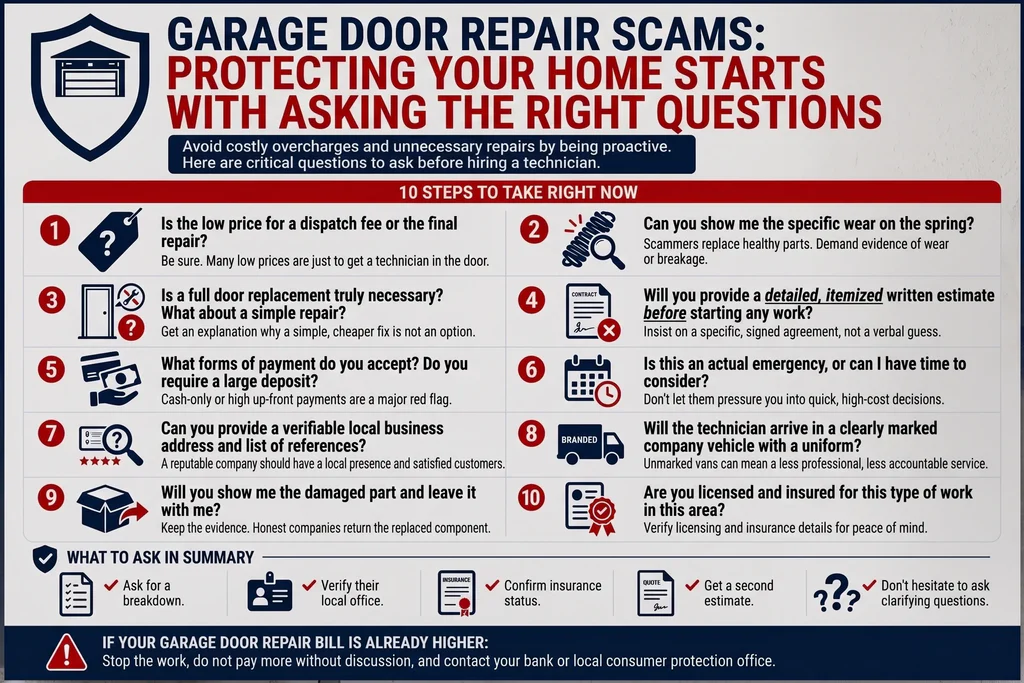
Most garage door scams rely on speed and pressure. The moment you slow down, ask for something in writing, or ask to see proof of license, the tactic stops working. If a technician resists any of those simple requests, that resistance is the clearest warning sign on this list.
Ocean Coast Garage Doors provides written estimates before any work begins and can produce license and insurance information on request. If you’d like a second opinion on a quote you’ve already received, contact us today or give us a call to book a free quote or same-day inspection with our team.
Frequently Asked Questions
Is it normal for a quote to change after the technician arrives?
A small adjustment is normal for something unseen over the phone. A drastic jump is not. Our rule of thumb: any change should be explainable and shown to you, not just stated.
Do all garage door companies require full payment upfront?
No. Legitimate companies collect payment once the job is done. Full payment upfront, especially cash only, is one of the more consistent red flags we see across home repair services generally.
How can I check if a garage door technician is actually licensed?
Ask directly for the license number before you schedule. A real technician gives it without hesitation; a vague answer is worth taking seriously.
Why did the technician say my spring needs replacing when the door still opens fine?
This is one of our most common calls for a second opinion. A genuinely failing spring shows physical signs: gaps in the coil, an uneven door once disconnected from the opener, or noticeably harder lifting. If none of that is present, ask what test was used.
What should a legitimate written estimate include?
A real estimate breaks out parts and labor separately with a total before work begins. A verbal-only number is worth pausing on.
Is it a red flag if a company doesn't have a local address?
Yes. A quick search should turn up a real address and reviews with some history. Out-of-area call centers dispatching under a local-sounding number are a pattern we've seen reported often enough to flag directly.
How do I know if a price is too low to be real?
If one quote is dramatically lower than others, it's either going to change on-site, or the workmanship will be lower quality than what you're comparing it against.
Should I be worried if there's no warranty offered on the repair?
Yes. A company that stands behind its work states the terms without checking with anyone. No warranty, or a vague one, means you're on your own if something fails shortly after.
What should I do if I think I've already been scammed?
Get a second opinion in writing, and report the business to the Better Business Bureau and your local consumer protection office. Documenting the original quote versus the final price helps if you need to dispute a charge.


