Most homeowners do not think about their garage door until something goes wrong. It opens, it closes, and as long as it does both, it tends to stay off the radar. The problem is that waiting for a full breakdown before taking action almost always costs more than catching the warning signs early, along with garage door service and repair.
Knowing when to replace or upgrade your garage door is not just about avoiding inconvenience. It is about protecting your home’s security, maintaining its curb appeal, and making a smart financial decision before a minor issue becomes a major expense. For homeowners in Irvine, CA, where property values are strong and neighborhood standards are high, timing this decision well can make a meaningful difference.
This guide walks you through the clearest signs that your garage door is telling you it is time for a change, and what to do when you spot them.
The Door Has Visible Damage That Goes Beyond Cosmetic
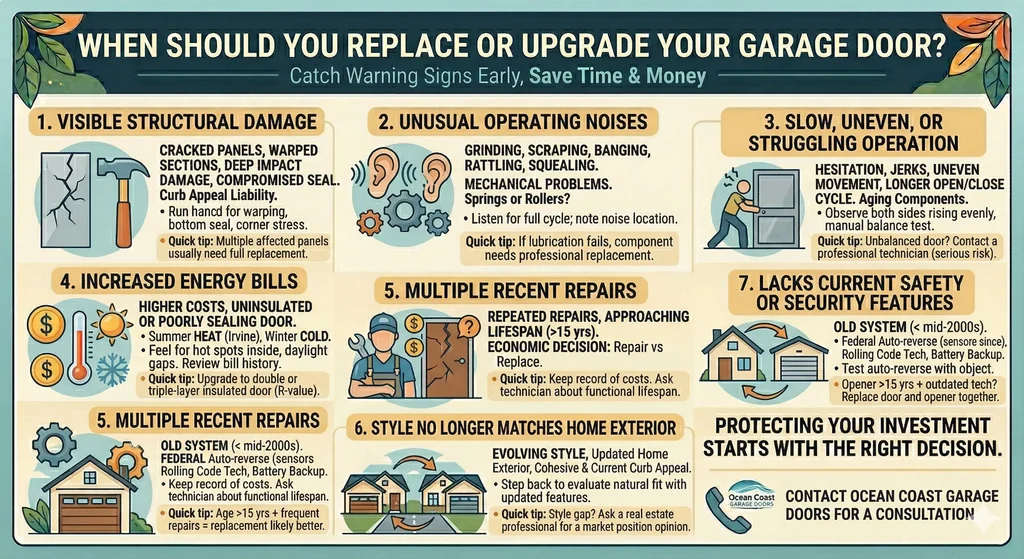
A dent here or a scratch there is normal wear. But when damage becomes structural, it crosses a line that cosmetic repairs cannot fix. Cracked panels, warped sections, and deep impact damage compromise the door’s ability to seal properly, operate smoothly, and protect your garage from weather and intruders.
Visible structural damage also affects your home’s curb appeal in ways that are hard to overlook. In neighborhoods where exteriors are well-maintained, a damaged garage door stands out immediately and can work against you if you are planning to sell.
What to check:
- Run your hand along each panel and look for warping, bowing, or sections that no longer sit flush
- Check the bottom seal for cracks or gaps that allow light, air, or pests to enter
- Inspect the corners of each panel where stress concentrations tend to cause cracking first
For context on how style and material choices affect the long-term performance and maintenance demands of your door, What Are the Most Popular Garage Door Styles? provides a detailed breakdown of what each option brings in terms of durability and upkeep.
The Door Is Making Unusual Noises During Operation
A well-maintained garage door should operate with minimal noise. Grinding, scraping, banging, rattling, or squealing during operation are not just annoying. They are symptoms of mechanical problems that tend to get worse the longer they are left unaddressed.
Common causes behind unusual garage door noises include:
- Grinding or scraping: Often points to worn rollers, misaligned tracks, or a lack of proper garage door maintenance, such as lubrication on moving parts
- Banging or popping: Can indicate a loose or broken spring, which is a serious safety concern that requires immediate professional attention
- Rattling: Usually caused by loose hardware, including bolts, hinges, or brackets that have worked themselves loose over time
- Squealing: Typically a sign that rollers or hinges need lubrication or replacement
What to check: Listen carefully during a full open and close cycle. Note where in the cycle the noise occurs, whether at the start, midway, or at the end, as this can help a technician identify the source more quickly.
The Door Is Slow, Uneven, or Struggling to Operate
A garage door that hesitates, jerks, moves unevenly, or takes noticeably longer to open and close than it used to is a door that is working harder than it should. This kind of performance decline is often a symptom of aging components rather than a single isolated failure.
Uneven movement in particular deserves immediate attention. If one side of the door rises or lowers faster than the other, it usually indicates a spring or cable issue. Operating a door in this condition puts additional stress on the garage door opener motor and can accelerate the failure of other components.
What to check:
- Watch the door move through a full cycle from a safe distance and observe whether both sides rise and lower at the same rate
- Check whether the door pauses, reverses unexpectedly, or requires multiple attempts to complete a full open or close cycle
- Test the manual release and try lifting the door by hand. A properly balanced door should stay in place when raised halfway without assistance
Your Energy Bills Have Increased Without a Clear Reason
An aging or uninsulated garage door can be a surprising contributor to higher energy costs. If your garage is attached to your home, a door that no longer seals properly or lacks adequate insulation allows outside temperatures to affect the interior of the attached space, which in turn puts more demand on your home’s heating and cooling system.
In Irvine, CA, where summer temperatures regularly climb and the sun exposure is strong, an underperforming garage door can make a noticeable difference in how hard your HVAC system works during warmer months.
What to check:
- Stand inside the garage on a warm day with the door closed and feel for hot spots near the door surface or along the sides and bottom seal
- Look for daylight visible around the edges of the door when it is fully closed, which indicates gaps in the seal
- Review your energy bills over the past year and note whether costs have increased without a corresponding change in usage habits
The Door Has Been Repaired Multiple Times in Recent Years
Every garage door has a natural lifespan. Springs, cables, rollers, and panels all have finite service lives, and a door that has required repeated repairs is often approaching the point where replacement becomes more economical than continued maintenance.
A useful way to think about this is the repair versus replace calculation. If the cost of the next repair approaches or exceeds a significant portion of the cost of a quality replacement door, replacement is almost always the better financial decision. You stop paying for recurring repairs and start benefiting from a new door with a fresh warranty and better performance.
What to check:
- Keep a simple record of repairs and their approximate costs over the past three to five years
- Ask your technician directly whether the door is approaching the end of its functional lifespan
- Factor in the age of the opener as well, since an aging opener paired with a new door may still underperform
The Style No Longer Matches Your Home’s Exterior
Sometimes the issue is not mechanical at all. Garage door styles evolve, home exteriors get updated, and a door that fit perfectly 15 years ago can start to feel like a mismatched afterthought once the rest of the home has been refreshed.
A style upgrade is worth considering if your home has been repainted, re-sided, or renovated in ways that have shifted its overall aesthetic. It is also worth considering if you are preparing to sell and want the exterior to feel cohesive and current to attract the strongest possible buyer interest.
What to check:
- Step back to the curb and evaluate whether the garage door feels like a natural part of the home’s current exterior or a leftover from a previous version of it
- Compare your door’s style, color, and finish to those on comparable homes in your neighborhood
- Consider how the door will photograph, since listing photos are most buyers’ first impression of any property
Understanding how style choices connect to property value is a natural next step once you have identified a style gap. Why Your Garage Door Style Affects Your Home’s Value digs into exactly how different materials and designs compare when it comes to curb appeal and return on investment.
Your Garage Door Lacks Current Safety Features
Garage door technology has advanced significantly over the past two decades. Doors and openers manufactured before the mid-2000s may be missing safety features that are now standard and, in some cases, required by current building codes.
Key safety features to look for in a current door and opener system include:
- Auto-reverse function: Sensors at the base of the door detect obstructions and automatically reverse the door if something is in the path of closing. This feature has been federally required on new openers since 1993, but older systems may not have it, or it may have stopped functioning correctly.
- Manual release: Allows the door to be operated by hand in the event of a power outage or opener failure.
- Rolling code technology: Modern openers change the access code with each use, making it significantly harder for unauthorized access through code scanning.
- Battery backup: Keeps the door operational during power outages, which is particularly useful in areas where outages are a regular occurrence.
What to check: Test your door’s auto-reverse function by placing a flat object like a piece of lumber on the ground in the door’s path and closing the door. If it does not reverse upon contact, the safety sensor system needs immediate attention from a professional technician.
Regular inspection and maintenance of garage door systems is recommended to ensure safety features such as auto-reverse systems and sensors continue functioning properly.
The Door No Longer Operates Securely
Security is one of the most fundamental functions of a garage door. A door that does not close completely, lock reliably, or resist manual force from the outside is a vulnerability that goes beyond inconvenience.
Common security-related failure signs include:
- The door does not sit flush against the ground when fully closed, leaving a gap along the bottom
- The locking mechanism is damaged, missing, or no longer engages properly
- The door can be lifted manually from the outside with minimal effort, even when the opener is engaged
- The opener remote responds inconsistently or can be triggered by neighboring remotes due to outdated frequency technology
What to check: With the door fully closed and the opener engaged, try lifting the door from the outside using the handle. There should be firm, consistent resistance. If the door moves at all, the security of the system deserves a professional evaluation.
If you are now thinking about which replacement style makes the most sense for your home, How to Choose the Right Garage Door Style for Your Home walks you through every key factor in that decision, from architecture and material to budget and neighborhood standards.

Acting Before the Door Acts for You
The most expensive garage door situations are almost always the ones that could have been avoided with earlier action. A door that has been showing warning signs for months does not give you a polite final notice before it fails completely. It simply stops working, often at the least convenient moment.
Ocean Coast Garage Doors helps Irvine, CA, homeowners assess their current door, understand their options, and move forward with confidence. Contact us today or give us a call to schedule your inspection and find out whether a repair, upgrade, or full replacement is the right call for your home.
Frequently Asked Questions
[sp_easyaccordion id=”3934″]